In 1834, a Polish expatriate named Johan Lotski, a botanist, discovered gold in the Livingstone
Creek, at the town’s present location. But his claims fell on deaf ears.
It wasn’t until 1851 that the Reverend W B Clark, a noted geologist reported that he had found
evidence of gold in quantities that would make the mining of it economically feasible.
Alluvial deposits of gold were found in tributaries of the Livingston Creek, and by the end of 1854,
over 200 men were camped along its banks digging for gold, most of it being found within a metre
or so of the surface.
More and more miners and their families crossed the alps. Miners and their wives walked, while
their children made the journey in boxes and crates strapped to the sides of packhorses on tracks
that were harsh and unforgiving.
Among those to arrive on the Omeo goldfields were Chinese miners.
They first arrived in 1859. The majority of them had made the long journey over the alps from
Beechworth many of them arriving with no more than a pole with a sack at each end slung across
their shoulders.
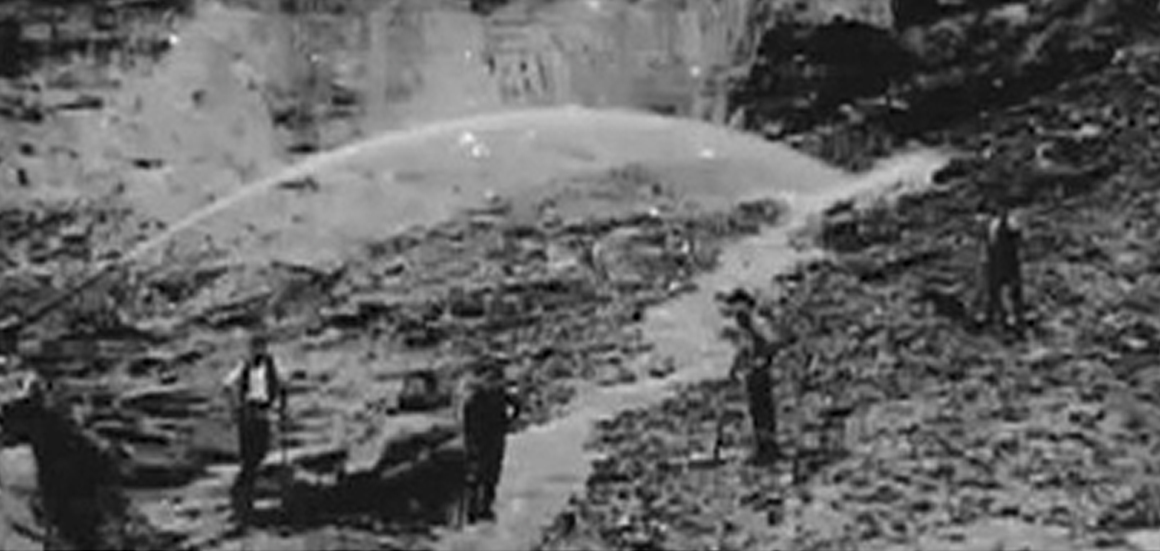
By 1855, most of the shallow alluvial gold had been mined and the process of hydro sluicing was
introduced to the Omeo goldfields.
In an operation that took nine months to complete a water race was constructed along the
mountain slopes for a distance of almost nineteen kilometres. Giant flumes crossed gullies and
ravines with the water arriving at about 190 feet above the creek and the alluvial deposits.
Races were cut from almost every stream that could supply water.
In the process, water blasted away the alluvial gold-containing gravel and the gravel slush was
channelled into rows of wooden sluice boxes and the gold ore collected.
The Oriental Claims area alone produced an estimated 58,000 ounces of gold.
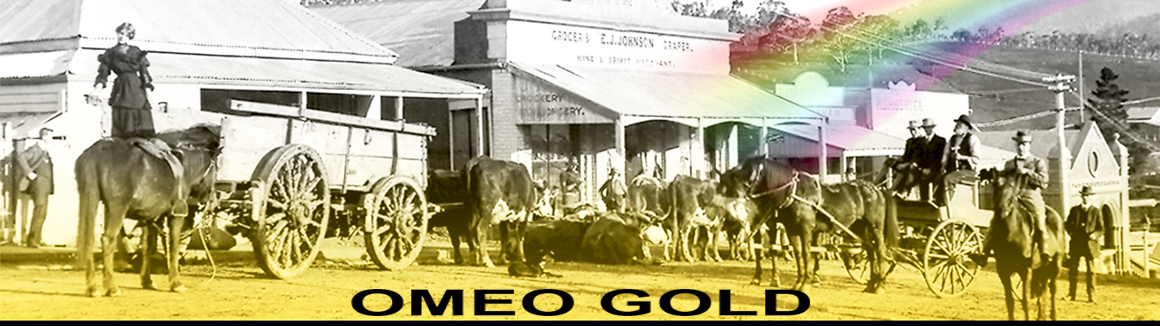
At a point when alluvial deposits were diminishing, a miner walked into E J Johnston’s general
store, the same store that I later was to own and manage, to cash in some gold. Johnston paid the
man his cash, but as he weighted the gold, he noticed something stuck to the pieces of ore.
It was quartz.
It heralded the meaning of reef mining. And a new boom. The first venture into quartz mining was
at the Dry Gully field with the first battery being established at Mountain Creek.
People came from all over the district to see a local identity, Miss Rogers, smash a large bottle of
champagne over the wheel as it started up, and christen it the Mountain Maid.
Bullock teams hauled multi-headed batteries up the mountains and across the alps to work the
new found reefs.
Smile of Fortune, Rip Van Winkel, Happy Go Lucky, The Joker, and Inexhaustible were some of
the names given to the many reef mines that opened up.
In 1914, many of the mines that were flourishing closed down.
The boom was over.
 OmeoGold